| |
| |
|
|
| |
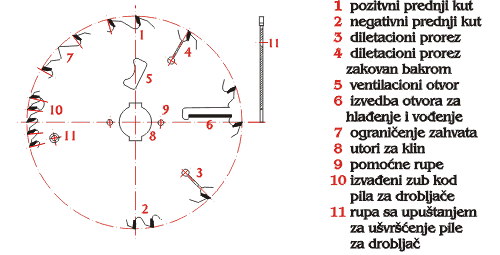
| In order to meet your wishes for
quality saw in the shortest possible time, we kindly ask you to
state in your order the following: |
| saw type (MA, SB etc.), saw diameter
D, cutting width B, hole diameter d, number of teeth Z, wedge groove,
number and diameter (for example 2 UK), accessory holes, number
and diameter of hole and diameter on which they are placed (for
example 2 PR10), type of material which is to be cutted, cut height
and number of turnings, feed speed, feed type (mechanical or manual) |
| |
| |
| |
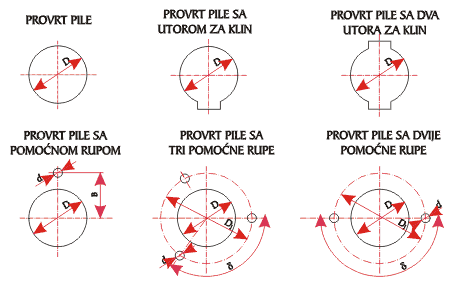
| the
most often types of circulat saw bores |
| |
| |
| |
| Geometry of tools's
cutting edge |
| |
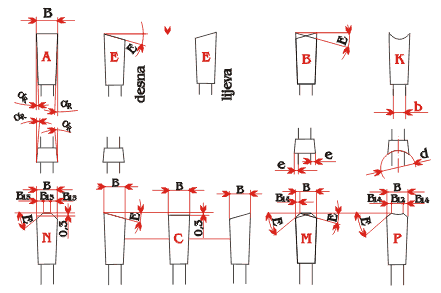
| Geometry of cutting part of circular
saws with HM tips depends on purpose and type of material which
is to be cutted. Picture shows standard tooth shapes : |
| |
| |
| |
| Instructions |
| |
| For long and correct work of tools
it is necessary to handle them carefully and to follow below stated
instructions: |
| - tools with cutting edge made of
HM are not to be placed on hard ground without protection |
| - machine reception parts, spindle
and flange, must be clean and within permited aberrations (see picture
1) |
| - it is necessary to control wedges
and clamping elements and to exchange them in case of destruction |
| - before placing of tool on the machine
it is necessary to check out the cutting edges so that they are
not broken or destroyed |
| |
| |
| |
| Circular saw at
work |
| |
|
 |
|
| For
obtaining a fine cut it is necessary to have at the
same time at least two teeth in operation. |
Vertical
saw measure “a”
should be max. 10 mm.
By increasing of size “a”
cut of surface A becomes
more quality.
By decreasing of size “a”
cut of surface B becomes
more quality.
|
|
| |
| Saw sheet is adjusted and stretched
in order to meet requests which occurs in exploitation process.
For right performance of the saw it is necessary to use flange of
corresponding diameter, which must not be smaller than ¼
of saw diameter. During selection of HM saw it is necessary to take
into consideration saw diameter, number of teeth, cut depth and
feed of working piece, as shown on diagram. |
| |
| |
| |
| Cutting speed |
| |
| The most appropriate cutting speed
is between 60 and 70 m/s.Crittical cutting speeds which are between
50 and 55 m/s should particularly be avoided since during these
speeds a great vibration on saw sheets can occure. The biggest cutting
speeds around 100 m/s can be used only with new machines of massive
construction in other words at strengthened thickness of saw sheets. |
| |
| Cutting
speed is calculated acc. to formula: |
| |
|
V
= |
D
 n |
m/s |
|
D = saw diametar |
| 60 |
n=number of axis turning
in one |
| |
minute (o/min.) |
| |
| Number of axis turning
is calculated acc. to following formula: |
| |
|
V
= |
60
v |
o/min |
|
|
D
|
| |
| Number
of axis turning in loaded condition is smaller than the number
of saw axis turning in unloaded condition for 2-6%. In table n1=n-4%. |
| |
| circular saws
- T.C.T. |
| |
|
|
|
code |
circular
saw T.C.T. |
tooth shape |
| 1450020 |
300
x 3,2 x 30 |
MA
20 |
| 1450030 |
350
x 3,5 x 30 |
MA
24 |
| 1450040 |
400
x 3,5 x 30 |
MA
28 |
| 1450830 |
250
x 3,2 x 30 |
VB
40 |
| 1450850 |
350
x 3,2 x 30 |
VB56 |
| 1450865 |
450
x 3,8 x 30 |
VB
72 |
| 1451010 |
300
x 4,2 x 30 |
VBS
48 |
| 1451025 |
400
x 4,2 x 30 |
VBS
64 |
| 1452220 |
200
x 3,2 x 30 |
FB
48 |
| 1452240 |
300
x 3,2 x 30 |
FB
72 |
| 1452260 |
400
x 3,2 x 30 |
FB
96 |
| 1452615 |
250
x 2,4 x 30 |
FBT
60 |
| 1452625 |
300
x 2,4 x 30 |
FBT
96 |
| 1455203 |
200
x 3,2 x 30 |
FN
64 |
| 1455230 |
300
x 3,2 x 30 |
FN
96 |
|
| |
| circular saws
- hard chromed |
| |
|
|
| code |
circular
saw |
tooth
shape |
| 1422160 |
300
x 2,0 x 70 |
PV
36 KOUUD |
| 1422206 |
300
x 2,5 x 70 |
PV
36 KOUUD |
| 1422326 |
300
x 3,0 x 70 |
PV
36 KOUUD |
| 1422386 |
350
x 2,8 x 70 |
PV
36 KOUUD |
| 1422455 |
350
x 3,0 x 70 |
PV
36 KOUUD |
|
| |