| |
| |
|
|
| |
| order should consist of the following: |
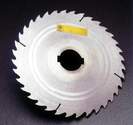
| saw diameter, tooth shape and number,
hole diameter acc. to drawing, cutting direction, geometry of tool's
cutting edge acc. to drawing, sort and condition of treated wood,
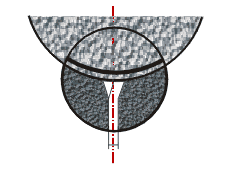
circular saw's machine, longitudal, transversal and frontal cut |
| |
| geometry
of tool's cutting edge |
| |
| |
| Sharpening of
circular saws |
| |
| Circular saws are sharpened with
grinding discs made of precious corundum, grain size 60-80, hardness
M and N and with ceramic fastener. Grinding discs with fastener
of synthetic gum are recommendable for especially fine grinding. |
| |
| |
Cutting
edge's geometry depends on tooth shape, cutting direction
with reference to wood fibers, wood sort and condition. |
| |
| tooth
shape |
blade geometry for length cut |
blade geometry for cross cut |
front angle   |
wedge angle |
front angle |
wedge
angle  |
| hard
wood |
soft
wood |
soft
wood |
hard
wood |
straight sharpening |
slope sharpening |
|
| KV |
28-30 |
22-24 |
38-42 |
40-45 |
18 |
5-10 |
55-60 |
| NV |
22 |
18 |
39-43 |
42-48 |
12 |
5-8 |
42-47 |
| PV |
28-30 |
22-24 |
45-49 |
45-49 |
- |
- |
40-56 |
| RS |
25-30 |
25-30 |
50-57 |
50-57 |
12-18 |
- |
42-60 |
| |
| Size
of overhouling depends on wood sort. |
| |
|
|
kind of wood |
size of overhouling on one side ( mm
) |
| hard
wood |
0,3
- 0,4 |
| conifer
- dry wood |
0,45
- 0,6 |
| conifer
- wet wood |
0,5
- 0,7 |
| soft
wood - wet |
0,7
- 1,0 |
|
|
|
code |
circular saw |
tooth shape |
|
| 1400010 |
160
x 1,4 x 25 |
NV
48 |
|
| 1400080 |
200
x 2,0 x 25 |
NV
56 |
|
| 1400140 |
250
x 2,5 x 25 |
NV
48 |
|
| 1400210 |
300
x 2,0 x 30 |
NV
56 |
|
| 1400280 |
350
x 2,2 x 30 |
NV
48 |
|
| 1400373 |
400
x 2,5 x 30 |
NV
56 |
|
| 1400440 |
450
x 2,8 x 30 |
NV
56 |
|
| 1400090 |
500
x 3,0 x 30 |
KV
56 |
|
| 1400120 |
600
x 2,8 x 30 |
KV
56 |
|
| 1400150 |
800
x 3,5 x 40 |
KV
56 |
|
| 1400045 |
900
x 4,0 x 40 |
KV
56 |
|
| 1400165 |
1000
x 4,5 x 40 |
KV
56 |
|
|
| |
| Cutting
speed |
| |
| The most appropriate cutting speed
is between 60 and 70 m/s. Critical cutting speeds which are between
50 and 55 m/s should particularly be avoided since during these
speeds a great vibrations on saw sheets can occure. The biggest
cutting speeds mentioned in table can be used only with new machines
of massive construction, in other words at strengthened thicknesses
of saw sheets. |
| |
| Cutting
speed is calculated acc. to following formula: |
| |
|
V
= |
D
 n |
m/s |
|
D=saw sheet diameter
in meters (m) |
| 60 |
n=number of axis turning
in one minute (o/min.) |
| |
| Number of axis turning
is calculated acc. to following formula: |
| |
|
n
= |
60
v |
o/min |
|
|
D
|
| |
| Number
of saw axis turning in loaded condition n1 is smaller than the
number of saw axis turning in unloaded condition for 2-6%. In
table n1=n-4% |
| |
|
Optimum and critical cutting speeds |
| |
| n |
1000 |
1500 |
2250 |
3000 |
3750 |
4500 |
5250 |
6000 |
7500 |
9000 |
10500 |
12000 |
135000 |
15000 |
| n1 |
960 |
1440 |
2160 |
2880 |
3600 |
4320 |
5040 |
5760 |
7200 |
8640 |
10080 |
11520 |
12960 |
14400 |
|
| |
| saw
blade diameter( mm ) |
cutting
speed r.p.m. |
| |
|
| |